WooCommerce vs. Shopify: Which Ecommerce Platform Is Right for Your Business?
Comparing WooCommerce and Shopify? Learn the differences in ownership, flexibility, costs, SEO, and scalability to determine which ecommerce platform is right for your business.
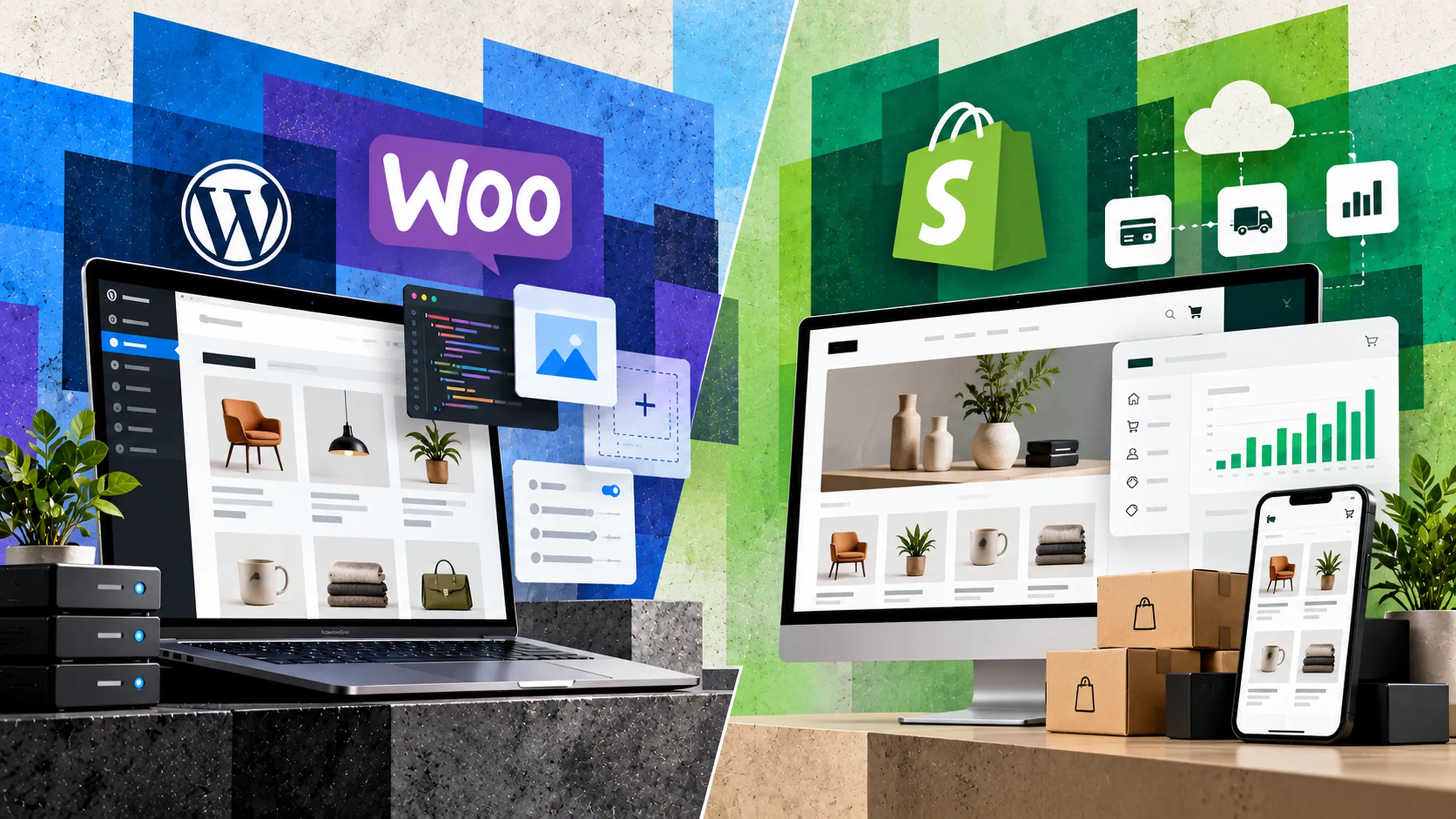
There’s no shortage of opinions online about WooCommerce and Shopify. Some business owners swear by Shopify’s simplicity, while others insist WooCommerce offers the flexibility every growing business needs.
The reality is much simpler: both are excellent ecommerce platforms. The right choice depends on what you’re selling, how you want to manage your business, and how much control you want over your online store.
If you’re planning to invest in ecommerce, understanding the differences between WooCommerce and Shopify now can help you avoid costly migrations, unnecessary limitations, and frustration as your business grows.
What Is WooCommerce?
WooCommerce is an ecommerce platform built specifically for WordPress. Rather than existing as a separate website builder, it transforms a WordPress website into a fully featured online store.
Because it’s built on WordPress, WooCommerce gives you complete control over nearly every aspect of your website—from its design and functionality to its hosting environment and customer experience.
Whether you’re selling ten products or ten thousand, WooCommerce is designed to grow alongside your business.
What Is Shopify?
Shopify is a hosted ecommerce platform designed specifically for online retail.
Unlike WooCommerce, Shopify manages the hosting, security, and much of the technical infrastructure for you. It’s designed to simplify launching an online store by keeping everything within a single ecosystem.
For many businesses, that’s exactly what they’re looking for. For others, those conveniences come with trade-offs.
Ownership Matters
One of the biggest differences between WooCommerce and Shopify has nothing to do with selling products.
It comes down to ownership.
With WooCommerce, you own your website, your hosting environment, your customer data, and your content. Because your store runs on WordPress, you’re free to choose your hosting provider, migrate your website whenever you like, and customize virtually every aspect of your business.
Shopify, on the other hand, is a proprietary platform. While you own your products and customer information, your store exists within Shopify’s ecosystem. If you ever decide to leave the platform, migrating your website can require significantly more planning.
For many business owners, that flexibility becomes increasingly valuable as their business grows.
Flexibility and Customization
Every ecommerce business is different.
Some businesses only need product pages and checkout. Others need appointment scheduling, wholesale pricing, memberships, customer portals, subscription billing, product configurators, CRM integrations, or custom workflows.
This is where WooCommerce excels.
Because it’s built on WordPress, WooCommerce can be customized to support almost any business model. As your business evolves, your website can evolve with it.
Shopify also offers thousands of apps and integrations, but customization generally happens within Shopify’s framework. For many retailers, that’s perfectly acceptable. For businesses with unique requirements, WooCommerce often provides far more flexibility.
Which Platform Is Easier to Manage?
Shopify was designed to make ecommerce as simple as possible.
Many business owners appreciate having hosting, software updates, payment processing, and security handled from one dashboard.
WooCommerce requires a little more involvement because you’re managing a WordPress website rather than using an all-in-one hosted platform.
However, when your website is professionally built and maintained—as it is through my Website-as-a-Service (WaaS) model—you receive the flexibility of WooCommerce without worrying about software updates, security, backups, or ongoing maintenance.
SEO and Marketing
No matter how good your products are, customers still have to find them.
Both WooCommerce and Shopify can perform well in search engines, but WooCommerce offers considerably more flexibility when it comes to technical SEO, content marketing, structured data, page optimization, and long-term growth strategies.
Because WooCommerce runs on WordPress, it’s especially well suited for businesses that plan to publish educational content, build resource libraries, create landing pages, or invest in long-term search engine optimization.
Cost Considerations
Many business owners assume Shopify is less expensive.
Sometimes that’s true.
Sometimes it isn’t.
Shopify combines hosting, software, and ecommerce into one monthly subscription, but additional apps, premium themes, and transaction fees can increase your overall costs.
WooCommerce itself is free, but you’ll need hosting and may choose premium plugins depending on your business needs.
Rather than focusing on the monthly subscription alone, it’s better to evaluate the total cost of ownership over several years.
Which Platform Do I Recommend?
Both platforms are excellent.
If you’re looking for a straightforward ecommerce solution with minimal customization and an all-in-one hosted experience, Shopify may be the right fit.
If you want complete ownership, exceptional flexibility, stronger long-term SEO opportunities, and the ability to customize your online store as your business grows, I believe WooCommerce is the stronger investment.
It’s the platform I recommend for most of my ecommerce clients because it gives them room to grow without forcing them into someone else’s ecosystem.
The Best Ecommerce Platform Is the One That Fits Your Business
Choosing between WooCommerce and Shopify isn’t about picking a winner.
It’s about choosing the platform that aligns with your business goals, your budget, and your long-term vision.
Every business is different, which is why I take the time to understand your products, your customers, and your growth plans before recommending a solution. My goal isn’t to sell you a particular platform—it’s to help you build an online store that’s positioned for long-term success.
[contact]