
Why Does It Cost So Much More to Compete Online Than It Used To?
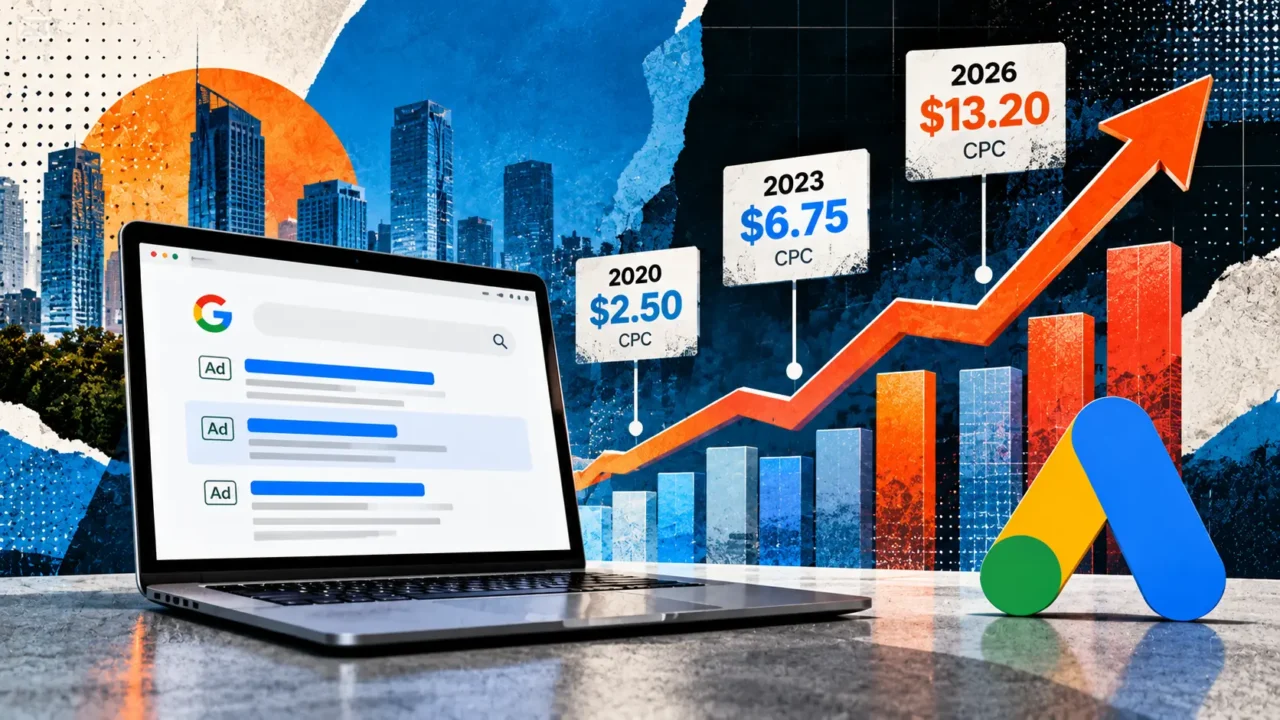
A client recently asked me a question I hear from business owners all the time:
“Five years ago, I could spend $500 a month on Google Ads and get great results. Now you’re telling me I need to spend almost three times that much just to get the same thing?”
He isn’t wrong.
And it isn’t simply because Google decided to raise its prices across the board.
The internet has become a far more competitive place to do business. More companies are advertising online, highly sophisticated businesses are competing for the exact same customers, and the amount those companies are willing to pay to acquire a customer has surged.
The reality for small businesses is straightforward: the same $500 advertising budget simply doesn’t buy what it used to.
Here is why digital acquisition costs have increased—and how businesses need to adapt.
1. Google Ads Is an Auction, Not a Fixed-Rate Billboard
One of the most common misconceptions about Google Ads is that you are buying advertising space from Google at a set rate.
You aren’t. You are participating in a live auction.
When someone searches for a phrase like “AC repair near me,” dozens of local companies want their ad displayed. Google uses an automated system to weigh bids, ad quality, landing page experience, and search context to determine who gets top placement.
That means the price of an ad isn’t set by Google alone—it’s driven by what your competitors are willing to pay. And today, far more businesses are taking digital advertising seriously than they were five or ten years ago.
2. The Secret Is Out: Your Competitors Know Google Works
There was a time when simply understanding the basics of digital marketing gave a small business a massive advantage.
Your competitors might have had broken websites, zero ad budget, or a “set-it-and-forget-it” campaign they hadn’t touched in three years.
While those businesses still exist, you are now far more likely to be competing against companies with:
- Professionally managed Google Ads accounts
- Mobile-optimized, high-converting landing pages
- Precise conversion tracking and analytics
- Dedicated local SEO strategies and aggressive monthly budgets
Digital marketing has matured. Businesses that once viewed online marketing as a side experiment now treat it as their primary engine for growth.
3. More Advertisers Chasing the Same Audience Means Higher CPCs
Imagine 1,000 people in your market search for your specific service each month.
Five years ago, maybe 8 to 10 local businesses actively competed for those searches. Today, 20 or 30 businesses are fighting for that exact same audience. The pool of potential customers hasn’t doubled just because the number of advertisers did.
To stay visible, competitors bid higher, raise monthly budgets, and hire agencies to refine their performance. Over time, the cost-per-click (CPC) climbs. That is why a $500 monthly budget that used to generate meaningful traffic now barely gives a campaign enough room to breathe.
4. You Aren’t Just Competing with the Shop Down the Street
Your competition isn’t always local anymore. Depending on your industry, you are likely bidding against:
- National franchises and regional brands
- VC-backed companies
- High-volume lead-generation platforms and aggregators
These larger entities often operate on fundamentally different economics. If a customer is worth $1,000 in lifetime value to a regional player, they may be perfectly content paying $200 or $300 to acquire them. A local business accustomed to paying $50 for that same lead gets priced out.
This is why focusing strictly on Cost Per Click is misleading:
- A $15 click isn’t automatically expensive.
- A $3 click isn’t automatically cheap.
What matters is the value generated after the click occurs.
5. Why Your Website Matters More Than Ever
As clicks become more expensive, wasting traffic becomes dramatically more painful.
- At $2 a click: A slow, confusing website that loses visitors is a minor nuisance.
- At $15 or $20 a click: A weak landing page or hidden contact form is a major leak in your business revenue.
If traffic gets more expensive, conversion becomes your highest-leverage asset. Improving the percentage of website visitors who actually call or fill out a form is often cheaper and far more effective than simply buying more traffic.
6. A Bigger Budget Doesn’t Automatically Fix the Problem
When $500 stops working, the knee-jerk reaction shouldn’t be to blindly throw $1,500 at the problem. Increasing an inefficient campaign’s budget just gives it more money to waste.
Before increasing spend, ask critical diagnostic questions:
- Are you targeting high-intent search terms, or are irrelevant searches draining cash?
- Are ads running in the correct geographic areas and during peak operating hours?
- Is conversion tracking configured correctly?
- Is the landing page clear, fast, and persuasive?
Once those fundamentals are locked down, however, you have to face market realities: you cannot optimize your way out of a budget that is simply too small for the market.
Shift the Question: From “Cheaper Clicks” to “Profitable Customers”
Costs for labor, rent, materials, and traditional media go up over time. Online customer acquisition is subject to the exact same economic forces.
Stop viewing your ad spend as a fixed historical expense (“I’ve always spent $500, so my budget is $500”). Instead, evaluate what it actually costs to compete for customers in today’s landscape.
The goal isn’t to chase cheaper clicks. The goal is to ask the right question:
“What does it cost to acquire a customer today, and does acquiring them at that price make financial sense for my business?”
That is the only number that ultimately matters.